
What is CIBIL Score? How It Is Calculated and Why It Matters for Credit Cards & Loans in India
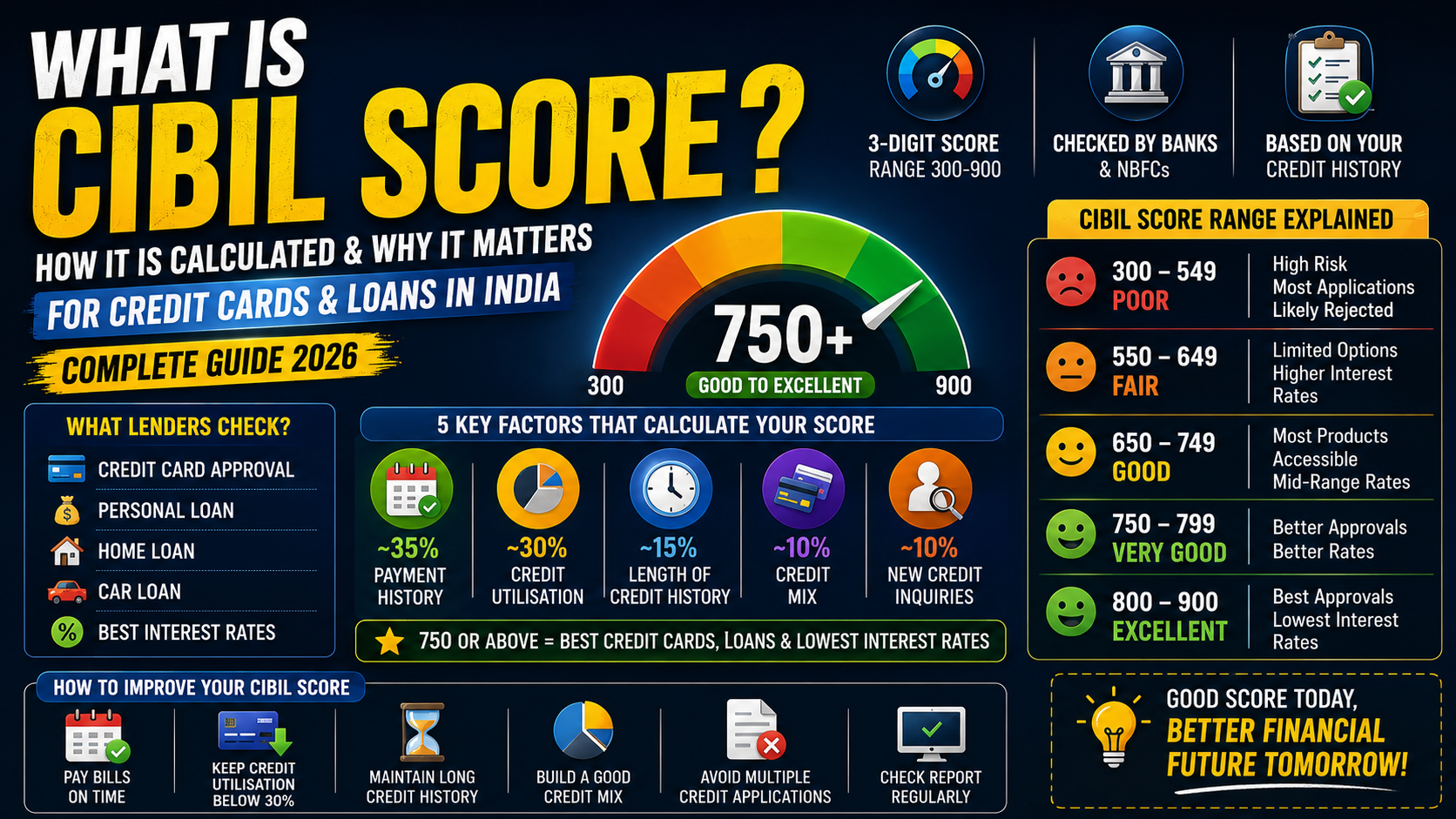
Your CIBIL score is a three-digit number between 300 and 900 that summarises your credit history. Banks and NBFCs check it every time you apply for a credit card, personal loan, home loan, or car loan. A score of 750 or above generally qualifies you for the best credit card offers and the lowest interest rates. A score below 650 will result in most applications being declined or approved only at higher interest rates. This guide explains exactly how the score is calculated, what each factor means in practice, what score you need for different financial products, and the specific steps you can take to build or repair your score.
In This Guide
What is a CIBIL Score?
CIBIL stands for Credit Information Bureau (India) Limited. TransUnion CIBIL is one of four credit bureaus licensed by the Reserve Bank of India (RBI); the others are Equifax, Experian, and CRIF High Mark. Each bureau maintains your credit report and generates a score.
The CIBIL score specifically refers to the score generated by TransUnion CIBIL, though lenders may check scores from any bureau. The score ranges from 300 to 900, with 900 being the highest possible.
Your credit report contains your complete history of credit accounts: all loans and credit cards, your payment history on each account, outstanding balances, and any defaults or write-offs. CIBIL calculates your score from this data using a proprietary model.
Lenders pull your credit report when you apply for any credit product. The inquiry itself is recorded on your report as a 'hard inquiry' and has a small negative effect on your score.
CIBIL Score Range: What Each Band Means
300-549 (Poor): High-risk profile. Most banks will decline applications outright. You may have one or more defaults, late payments, or a write-off on record.
550-649 (Fair): Below-average profile. Some lenders may approve secured products (against FD) but unsecured credit cards and personal loans are unlikely to be approved. Interest rates offered will be high.
650-749 (Good): Acceptable profile. Most standard credit cards and loans are accessible. You may not qualify for premium or super-premium cards, and interest rates will be mid-range.
750-799 (Very Good): Strong profile. Most credit cards including entry-to-mid-premium cards are accessible. Better interest rates on loans.
800-900 (Excellent): Best-in-class profile. Fastest approvals, best interest rates, and eligibility for premium credit cards that require high creditworthiness screening.
How CIBIL Score is Calculated: The 5 Factors
TransUnion CIBIL does not publish the exact weightage of each factor, but based on RBI disclosures and industry-standard credit modelling, the five factors and their approximate contribution are:
1. Payment History (~35%): Whether you pay your EMIs and credit card bills on time is the single largest factor. Even one missed payment can drop your score significantly. A payment 30+ days late is reported to credit bureaus by most lenders.
2. Credit Utilisation Ratio (~30%): This is your total outstanding balance divided by your total credit limit across all cards. If your combined credit limit is Rs 1,00,000 and you have outstanding balances totalling Rs 40,000, your utilisation is 40%. Keeping utilisation below 30% is recommended; below 10% is ideal for maximising your score.
3. Length of Credit History (~15%): The average age of all your credit accounts matters. Closing an old credit card reduces your average credit age and can lower your score. Keep older accounts open even if you do not use them frequently.
4. Credit Mix (~10%): Having a mix of secured credit (home loan, car loan) and unsecured credit (credit cards, personal loans) is viewed positively. Relying solely on credit cards is considered a weaker profile than a balanced mix.
5. New Credit Inquiries (~10%): Every time you apply for a new credit product, the lender performs a hard inquiry. Multiple hard inquiries in a short period signal credit-seeking behaviour and can reduce your score. Soft inquiries (like checking your own score) do not affect the score.
What Score You Need for Credit Cards and Loans
Entry-level credit cards (SBI SimplySAVE, HDFC MoneyBack, ICICI Coral): Generally approved at 700+. Some issuers will approve first-time credit users with a thin file at 650+ if income criteria are met.
Mid-tier cards (HDFC Regalia Gold, SBI Prime, Axis Ace): Generally require 720-750+.
Premium cards (HDFC Diners Club Privilege, Axis Magnus, ICICI Rubyx): Generally require 750+.
Super-premium cards (HDFC Infinia, Axis Reserve, SBI Aurum): Typically require 780+ and are often invitation-only or require high income proof.
Personal loans: Most banks require 700+. The best rates (below 12% p.a.) typically go to borrowers with 750+.
Home loans: Banks will lend at 650+, but the best rates require 750+. A lower score may result in a higher processing fee or higher interest rate.
Note: Eligibility criteria vary by lender. Banks also weigh income, employment type, existing obligations, and internal credit models alongside the CIBIL score.
How to Check Your CIBIL Score for Free
RBI mandates that every credit bureau provide one free credit report per year to consumers. You can claim your free report at:
TransUnion CIBIL: Visit myscore.cibil.com and create an account using your PAN card. One free full report per year; the score is available for free after verification.
Experian India: Visit experian.in/consumer/cibil-score.html for free annual report.
Alternatively, many banks and financial apps now show your CIBIL score for free within their apps - HDFC Bank, Axis Bank, BankBazaar, Paisabazaar, OneScore, and Bajaj Finserv all offer this. These are soft inquiries and do not affect your score.
Check your credit report (not just the score) at least once a year to look for errors - incorrect personal details, accounts that are not yours, or incorrectly reported late payments. Errors can be disputed directly with TransUnion CIBIL via their online dispute portal.
How to Improve Your CIBIL Score: Practical Steps
1. Pay every bill on time: Set up auto-pay for at least the minimum amount due on all credit cards. Even if you cannot pay the full outstanding, paying the minimum avoids a late payment being reported to the bureau. Note: paying only the minimum incurs interest charges - pay the full statement balance whenever possible.
2. Reduce your credit utilisation: If you consistently use more than 30-40% of your credit limit, request a credit limit increase from your bank (this adds capacity without adding debt) or pay down existing balances. Making mid-cycle payments (before the statement date) also reduces reported utilisation.
3. Do not close old credit cards: Each old account contributes to your credit age and available credit limit. Unless a card has a high annual fee with no matching benefit, keep it open and make at least one small transaction per quarter to keep it active.
4. Avoid multiple simultaneous applications: Space out credit applications by at least 3-6 months. Applying for five cards in a single month signals desperation for credit and generates multiple hard inquiries.
5. Dispute errors on your credit report: If you find any account that is not yours or any payment incorrectly marked as late, raise a dispute at TransUnion CIBIL's online portal. Resolutions typically take 30-45 days.
6. Build credit if you have no history: If you have no credit history, start with a secured credit card (issued against a fixed deposit). Use it for small, regular purchases and pay the bill in full each month. After 12-18 months of clean history, you will have a measurable score.
Common CIBIL Score Myths
Myth: Checking your own CIBIL score will lower it. Fact: Checking your own score is a soft inquiry. Only hard inquiries (by lenders when you apply) affect your score.
Myth: A high income automatically means a high CIBIL score. Fact: Income is not a factor in the score calculation. A high earner who pays bills late will have a low score.
Myth: Closing credit cards improves your score. Fact: Closing cards reduces your total available credit (increasing utilisation) and may reduce your average credit age. Both can lower your score.
Myth: You need to carry a balance on your credit card to build credit. Fact: Paying your bill in full each month is the ideal behaviour. Carrying a balance incurs interest and does not help your score.
Myth: CIBIL score improvement takes many years. Fact: If your score is low due to high utilisation (not defaults), reducing balances can show improvement within 1-2 billing cycles. Defaults and write-offs take longer - typically 2-3 years of clean history to significantly recover.
What is a good CIBIL score for a credit card in India?
750 and above is considered a good CIBIL score for most credit card applications. Scores between 700 and 749 may qualify for entry-level cards. Scores below 650 will face difficulty in most unsecured credit applications.
How long does it take to improve a CIBIL score?
If the low score is due to high credit utilisation, paying down balances can show improvement in 1-2 months. If the low score is due to missed payments or a default, consistent on-time payment for 12-24 months typically shows significant improvement, though severe defaults (write-offs) may take 3-5 years to fully recover from.
Does salary affect CIBIL score?
No. Your income is not a factor in CIBIL score calculation. The score is based entirely on your credit behaviour - payment history, utilisation, credit age, credit mix, and recent inquiries.
How many times can I check my CIBIL score for free?
TransUnion CIBIL provides one free full credit report per year. However, many banking apps and financial platforms (HDFC Bank app, Paisabazaar, OneScore) provide free score checks with no annual limit, as these count as soft inquiries.
Will a rejected credit card application hurt my CIBIL score?
The rejection itself does not appear on your report. However, the hard inquiry made by the bank before rejecting does appear and has a small negative impact. Multiple rejections in a short period mean multiple hard inquiries, which compound the negative effect.

Himangshu Mishra
Personal Finance Writer & Credit Card Analyst
3+ years researching Indian credit cards, banking products, and personal finance. Tracks RBI policy changes, bank fee revisions, and reward programme devaluations in real time.
Related from Personal Finance

Home Loan Eligibility Guide in India (2026): How to Qualify for the Highest Loan Amount and Lowest Rates
In 2026, securing a home loan in India has become more accessible for disciplined borrowers, yet stricter in ways that reward financial stability. With RBI-mandated updates to Loan-to-Value (LTV) ratios and faster credit reporting cycles delivering weekly updates, your eligibility is a dynamic assessment of repayment capacity, credit behaviour, and property specifics. A well-prepared applicant with a strong CIBIL score and stable income can now access up to 90% financing on smaller properties, longer tenures, and rates starting as low as 7.1-8.2% for salaried borrowers. This guide breaks down every criterion with 2026-specific nuances drawn from RBI guidelines and major lenders to help you move from borderline eligible to premium offer.

How to Improve Your CIBIL Score in India (2026 Tips): From Average (650-750) to Excellent (750+)
In India’s fast-evolving credit landscape of 2026, your CIBIL score is far more than a three-digit number-it is the silent gatekeeper to financial opportunities. Whether you are eyeing a home loan at 8.5% instead of 10.5%, a personal loan with minimal processing fees, or simply better terms on a car EMI, a score of 750 or above unlocks preferential treatment from lenders. Below 650, approvals become uphill battles with higher interest rates and stricter scrutiny. The national average sits in the 700-750 range, meaning millions are just one disciplined push away from elite status. With RBI’s weekly credit reporting now standard, positive changes reflect faster than ever before. This guide delivers battle-tested, 2026-specific strategies to accelerate your journey from average to excellent.

Loan Against Fixed Deposit in India (2026): Complete Guide to Features, Rates, Eligibility & Smart Strategies
In 2026, Loan Against Fixed Deposit (LAFD) remains one of the smartest, lowest-cost ways to unlock liquidity without breaking your savings. With FD rates still hovering in the 6-7.75% range, LAFD lets you borrow at just 1-2% above your deposit rate while your FD continues earning full interest. This creates a net borrowing cost that is often 70-80% lower than personal loans or credit cards. This guide draws on the latest June 2026 policies from SBI, HDFC, ICICI, Axis, Yes Bank, and RBI guidelines to help you use this facility effectively and responsibly.