
Loan Against Fixed Deposit in India (2026): Complete Guide to Features, Rates, Eligibility & Smart Strategies
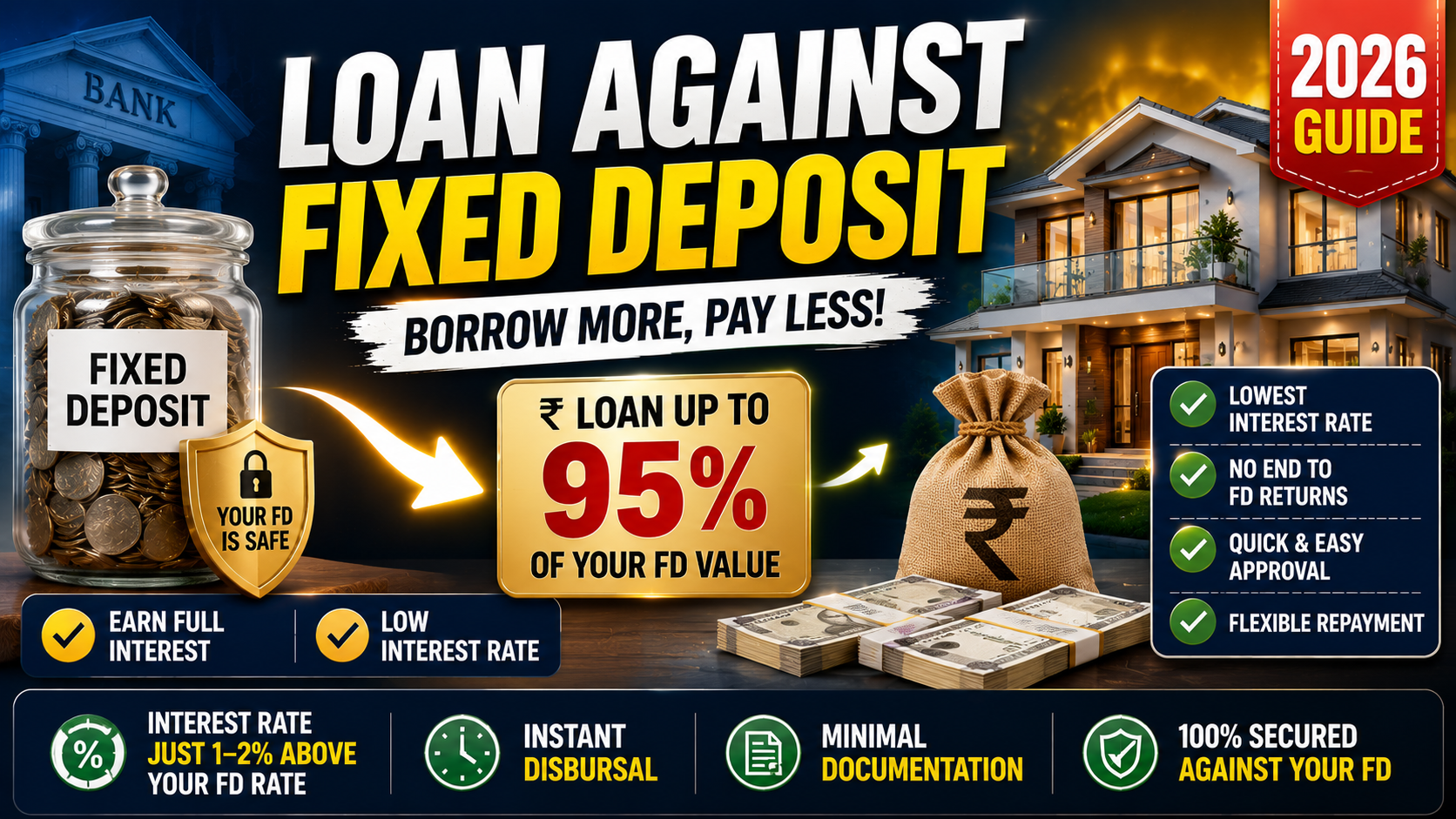
In 2026, Loan Against Fixed Deposit (LAFD) remains one of the smartest, lowest-cost ways to unlock liquidity without breaking your savings. With FD rates still hovering in the 6-7.75% range, LAFD lets you borrow at just 1-2% above your deposit rate while your FD continues earning full interest. This creates a net borrowing cost that is often 70-80% lower than personal loans or credit cards. This guide draws on the latest June 2026 policies from SBI, HDFC, ICICI, Axis, Yes Bank, and RBI guidelines to help you use this facility effectively and responsibly.
In This Guide
1. What Exactly Is a Loan Against Fixed Deposit?
A Loan Against Fixed Deposit is a fully secured borrowing facility where you pledge an existing FD as collateral. The bank places a lien on the deposit, allowing you to borrow 85-95% of its value without breaking or prematurely withdrawing the FD. Your deposit continues to earn the original contracted interest rate for the full remaining tenure.
The loan is usually structured as an overdraft or demand loan. You pay interest only on the amount you actually use and only for the exact period you use it. This makes LAFD ideal for temporary liquidity needs - medical emergencies, business opportunities, home renovations, or bridging short cash-flow gaps - without sacrificing the power of compounding on your savings.
2. Eligibility Criteria in 2026: Who Can Apply?
Because the loan is 100% secured by your own money, eligibility is deliberately simple and lenient. You must hold a valid FD with the same bank and be a resident Indian individual aged 18 years or above. HUFs, sole proprietorships, partnership firms, companies, societies, clubs, and trusts are also eligible.
Joint FDs are allowed, but all holders usually need to sign the pledge form. Exclusions are limited: FDs in a minor’s name (unless the guardian qualifies), tax-saver 5-year FDs in certain banks, and FDs already under lien for another facility. NRIs can avail LAFD against NRE/NRO FDs with slightly different documentation.
No strict income proof or high CIBIL score is required in most cases - a soft check or no credit check is the norm.
3. How Much Can You Borrow & What Are the Current Interest Rates?
You can typically borrow 85-95% of your FD’s principal value (LTV ratio). The interest rate is a small spread of just 1-2% over your FD’s contracted rate - far lower than any unsecured borrowing option.
| Bank | Spread over FD Rate | Max LTV | Facility Type |
|---|---|---|---|
| SBI | +1% | 90% | Overdraft |
| HDFC Bank | +2% | 90% | Overdraft |
| ICICI Bank | +2% | 90% | Demand Loan/OD |
| Axis Bank | +2% | 85% | Overdraft |
| Yes Bank | +1% | 90% | Overdraft |
Real-world example (June 2026): You have a ₹10 lakh FD earning 6.50%. From SBI you can borrow up to ₹9 lakh at 7.50%. Interest is charged only on the utilised amount. If you draw ₹3 lakh for 4 months and repay, your total interest cost is roughly ₹7,500-9,000 while your entire FD continues earning full interest.
4. Step-by-Step: How to Apply for Loan Against FD in 2026
The entire process is 100% digital at almost every major bank and takes 15 minutes to a few hours.
1. Log into your bank’s internet banking or mobile app. 2. Navigate to Loans → Loan Against FD / Overdraft Against Deposit. 3. Select the eligible FD and enter the required amount (within LTV limit). 4. Accept the lien/pledge terms - the system automatically marks the lien. 5. Funds are credited instantly or within hours to your linked savings/current account.
No physical documents, income proof, or branch visit is required if your KYC is already updated. Offline branch applications are still available but rarely needed.
5. Key Benefits That Make LAFD Stand Out
Ultra-low effective borrowing cost (net spread of only 1-2%). Your FD continues earning full interest with no premature withdrawal penalty or loss of compounding. Minimal or zero impact on your CIBIL score. Zero or nominal processing fees and often free prepayment. Same-day or next-day disbursal. Full flexibility to draw and repay multiple times within the FD tenure (overdraft mode). Tax efficiency - FD interest remains taxable as before, but the overall cost is far lower than alternatives.
6. Potential Drawbacks & Risks You Must Know
The biggest risk is default. If you fail to repay by FD maturity, the bank will automatically liquidate the deposit to recover principal, interest, and charges. There is an opportunity cost of the 1-2% spread. The pledged FD cannot be withdrawn, renewed, or used as collateral elsewhere until the loan is fully closed. Even if you borrow only 30% of the limit, interest is still calculated only on the utilised portion - but you must monitor repayments carefully.
7. LAFD vs. Breaking FD vs. Personal Loan: A 2026 Decision Framework
A simple rule of thumb: Use LAFD for temporary needs lasting 3-18 months. Break the FD only for very short-term needs (under 3 months) where the penalty is lower than the loan interest. Choose a personal loan only if you need to borrow significantly more than your FD value, as rates are 10-18% and there is no FD interest benefit.
In most realistic scenarios, LAFD delivers the lowest net cost while preserving your savings growth.
8. Smart Strategies & Pro Tips for 2026
Pledge only the exact FD(s) you need - keep other FDs free for true emergencies. Use overdraft mode and repay in chunks to minimise interest. Monitor rates: if FD rates rise, some banks allow switching to a higher-rate FD. Use LAFD as a temporary bridge while waiting for salary bonus, investment maturity, or business inflows. Review your pledged FDs annually and plan repayment or rollover well before maturity.
Final Thoughts: When LAFD Becomes a Financial Superpower
Loan Against Fixed Deposit in 2026 is far more than a simple borrowing product - it is a sophisticated liquidity management tool that respects the power of compounding. In an environment of steady FD rates and digital-first banking, LAFD gives you access to your own money at the lowest possible cost without sacrificing future growth.
The smartest savers treat their FD as a dual-purpose asset: a high-yield parking vehicle that doubles as an on-demand, low-cost credit line. When used responsibly, LAFD remains one of the most efficient financial levers available to Indian households and businesses today.

Himangshu Mishra
Personal Finance Writer & Credit Card Analyst
3+ years researching Indian credit cards, banking products, and personal finance. Tracks RBI policy changes, bank fee revisions, and reward programme devaluations in real time.
Related from Personal Finance
Home Loan Eligibility Guide in India (2026): How to Qualify for the Highest Loan Amount and Lowest Rates
In 2026, securing a home loan in India has become more accessible for disciplined borrowers, yet stricter in ways that reward financial stability. With RBI-mandated updates to Loan-to-Value (LTV) ratios and faster credit reporting cycles delivering weekly updates, your eligibility is a dynamic assessment of repayment capacity, credit behaviour, and property specifics. A well-prepared applicant with a strong CIBIL score and stable income can now access up to 90% financing on smaller properties, longer tenures, and rates starting as low as 7.1-8.2% for salaried borrowers. This guide breaks down every criterion with 2026-specific nuances drawn from RBI guidelines and major lenders to help you move from borderline eligible to premium offer.

How to Improve Your CIBIL Score in India (2026 Tips): From Average (650-750) to Excellent (750+)
In India’s fast-evolving credit landscape of 2026, your CIBIL score is far more than a three-digit number-it is the silent gatekeeper to financial opportunities. Whether you are eyeing a home loan at 8.5% instead of 10.5%, a personal loan with minimal processing fees, or simply better terms on a car EMI, a score of 750 or above unlocks preferential treatment from lenders. Below 650, approvals become uphill battles with higher interest rates and stricter scrutiny. The national average sits in the 700-750 range, meaning millions are just one disciplined push away from elite status. With RBI’s weekly credit reporting now standard, positive changes reflect faster than ever before. This guide delivers battle-tested, 2026-specific strategies to accelerate your journey from average to excellent.

Credit Card Settlement Impact on CIBIL Score in India (2026): Everything You Need to Know Before You Settle
If you’re struggling with a big credit card bill you simply can’t pay, the bank may offer you a “settlement”. You pay a smaller lump-sum amount and the rest is waived. Sounds like relief, right? But before you say yes, you need to understand exactly what it does to your CIBIL score. In this simple and honest 2026 guide, we explain everything in plain English - no complicated banking jargon.