
RuPay Credit Cards on UPI: RBI’s Ambitious Push for Credit Inclusion Meets Issuer Caution and Merchant Pushback
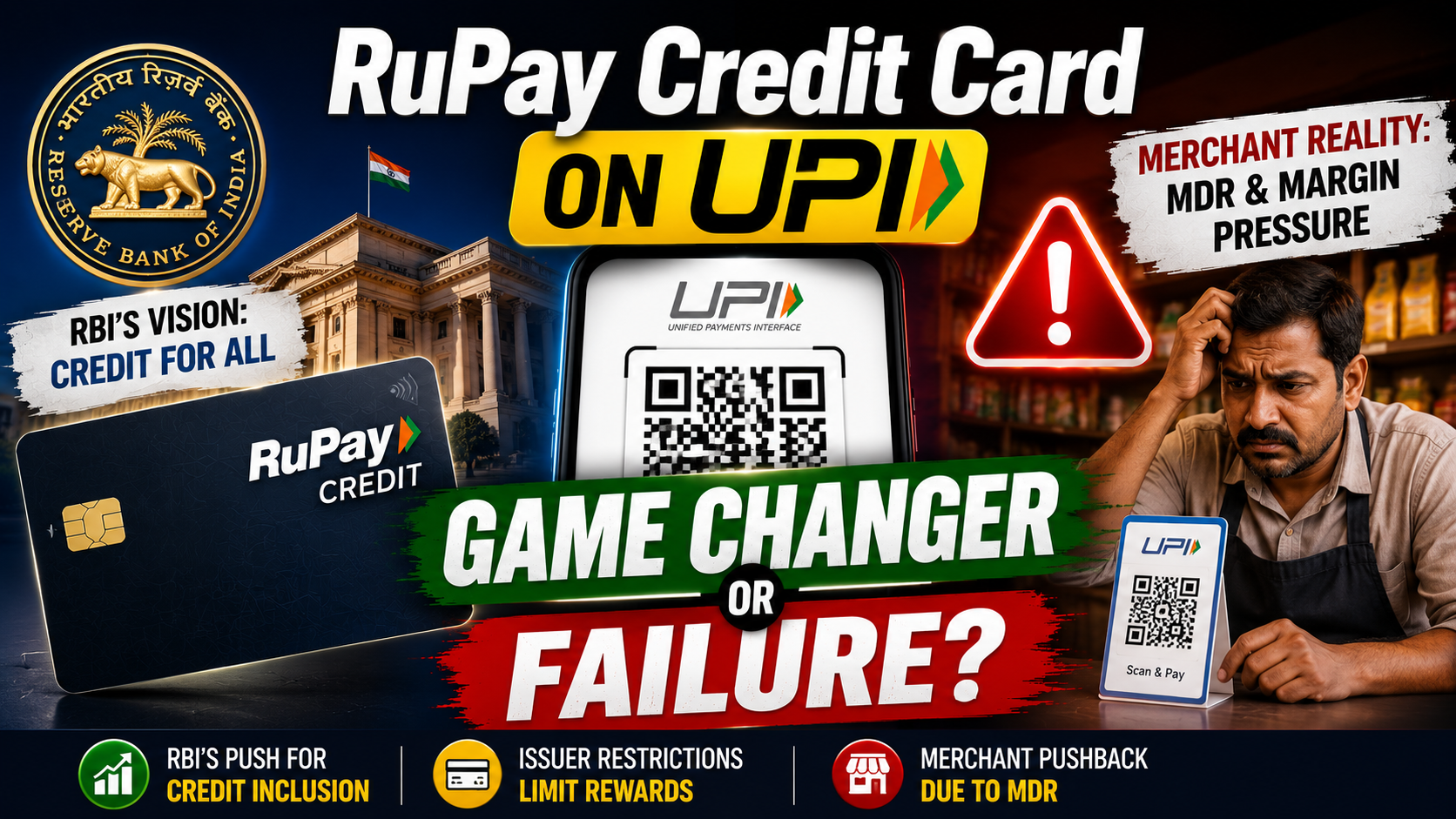
India’s payments ecosystem stands as one of the most dynamic in the world, with the Unified Payments Interface (UPI) handling billions of transactions monthly and reshaping how money moves across the country. Against this backdrop, the Reserve Bank of India (RBI) and the National Payments Corporation of India (NPCI) have long viewed the integration of RuPay credit cards with UPI as a pivotal lever for expanding formal credit access. By linking RuPay credit cards to UPI apps, consumers gain the ability to pay at millions of QR code-enabled merchants without needing a point-of-sale (POS) terminal-combining the instant convenience of UPI with the credit flexibility and rewards typically associated with plastic cards.
In This Analysis
The Structural Promise: Credit Where POS Never Reached
At its core, RuPay credit cards on UPI represent a clever convergence of two homegrown successes. UPI’s zero-MDR (merchant discount rate) model for debit and bank account transactions encouraged explosive merchant onboarding. RuPay, as India’s indigenous card network, offered lower interchange costs compared to international schemes in many cases and aligned with national priorities for self-reliance. Linking the two allowed credit lines to flow through the same lightweight QR infrastructure that powers everyday UPI payments.
Early data underscores the potential. Industry reports indicate that UPI-linked RuPay credit cards have driven a significant portion of recent credit card growth, with users in smaller cities showing higher engagement due to the removal of POS friction. Average ticket sizes on these transactions tend to be lower than traditional card swipes, reflecting genuine small-merchant usage rather than high-end retail. NPCI and RBI have consistently highlighted this as a pathway to expand credit penetration, especially among first-time borrowers and micro-enterprises.
Issuer Realities: Rewards Come with Strings Attached
For consumers, the headline appeal of credit cards on UPI lies in earning rewards on everyday spends that were previously debit-only. Yet most RuPay issuers have introduced deliberate guardrails that limit upside, reflecting their own cost calculations around interchange income, fraud risk, and customer acquisition economics.
Consider a few prominent examples that illustrate the pattern. The Tata Neu RuPay credit card (issued by HDFC Bank) offers tiered rewards that heavily favour usage within the Tata Neu ecosystem. On general UPI spends outside the Tata Neu app, effective cashback drops to around 0.5% in NeuCoins. Jupiter’s Edge+ RuPay credit card (partnered with CSB Bank) takes a stricter approach. Rewards are available exclusively for transactions originating within the Jupiter UPI app. Bank of Baroda’s Eterna RuPay card reportedly de-rates acceleration on UPI Scan & Pay transactions. Scapia’s Federal Bank RuPay variant offers an attractive 5% reward, but only on transactions of ₹500 or more. IDFC FIRST Bank’s Digital RuPay credit card applies a tier: 1X rewards on UPI spends below ₹2,000 and 3X above that threshold.
These restrictions are not arbitrary. Issuers face real P&L pressures. By gating full benefits behind proprietary apps, minimum spends, or tiered thresholds, banks protect margins while still participating in the RBI-mandated ecosystem. The outcome, however, is that consumers hunting for unrestricted rewards often find RuPay UPI less compelling than traditional card usage.
Merchant Economics: The MDR Friction That Refuses to Fade
Even when issuers enable the feature generously, merchant behaviour determines real-world availability. Here lies perhaps the biggest bottleneck. UPI’s foundational success was built on zero or near-zero MDR for merchants on debit and account transfers. Credit card transactions, however, carry a merchant discount rate-typically around 2% for RuPay credit cards on UPI.
For a kirana store or street vendor operating on razor-thin margins, a 2% hit on every credit transaction erodes profitability quickly. Many merchants respond by disabling the credit card option entirely on their UPI QR codes, or by refusing RuPay credit payments above certain thresholds. While technically over 65 million UPI QRs exist, the effective acceptance rate for credit card payments is far lower.
Adoption Data: Impressive Growth, Yet Far from Saturation
Quantitative progress is undeniable. RuPay credit card volumes on UPI have shown triple-digit percentage growth in key periods, contributing to overall credit card transaction expansion. Yet context matters. Total UPI transactions dwarf credit flows, and traditional debit UPI still dominates merchant payments. Credit card on UPI remains a niche behaviour for many users-often reserved for higher-value or planned spends rather than daily use. Awareness gaps and occasional technical declines also add friction.
What Must Evolve for True Mainstream Status
For RuPay credit cards on UPI to move beyond early-adopter status, three pillars need attention. First, issuers must simplify reward structures. Second, merchant economics require attention: targeted incentives or tiered MDR could reduce resistance. Third, continued regulatory nudges and awareness drives will help close knowledge gaps.
In the end, RBI’s vision is sound: a payments system where credit is as ubiquitous and effortless as UPI itself. The technology exists. The policy scaffolding is in place. What remains is alignment of incentives across issuers, merchants, and consumers. Until those pieces click into place, RuPay credit cards on UPI will continue their steady but measured ascent.

Himangshu Mishra
Personal Finance Writer & Credit Card Analyst
3+ years researching Indian credit cards, banking products, and personal finance. Tracks RBI policy changes, bank fee revisions, and reward programme devaluations in real time.
Related from Credit Cards

Maximizing Value on Premium Tech: HSBC's Accelerated Rewards Offer on Apple Products Through the Unicorn Portal
Apple products command a premium in the Indian market for good reason. From the seamless ecosystem integration of iPhones and MacBooks to the reliability of AirPods and iPads, these devices represent not just gadgets but long-term investments in productivity, creativity, and lifestyle. Yet their high price tags often prompt savvy buyers to seek ways to offset costs. HSBC has stepped in with a structured opportunity that transforms these purchases into a high-yield proposition for eligible credit cardholders. By routing transactions exclusively through the dedicated HSBC-Unicorn portal, cardholders can unlock accelerated reward points that deliver meaningful returns when redeemed strategically.

IndusInd Tiger Credit Card Review 2026: Lifetime Free with 6% Air India Miles & Unlimited Lounges
The IndusInd Tiger Credit Card just got a massive upgrade in 2026. It is still completely Lifetime Free, yet now gives you up to 6% Air India miles thanks to a new 1:1 transfer ratio. On top of that you get 8 domestic lounge visits, 2 international lounges, free movies, free golf, and one of the lowest forex markups in the Lifetime Free segment. In this simple and honest review, we break down everything - rewards, eligibility, fees, lounge access, and whether this card is actually worth applying for.

IDFC FIRST Millennia Credit Card 2026 Deep Dive: Lifetime-Free Rewards King Just Got a Massive June Upgrade
The IDFC FIRST Millennia Credit Card is one of the few genuinely lifetime-free cards in India that has improved rather than deteriorated over time. Effective 18 June 2026, IDFC FIRST is making a meaningful structural change: the Rs 20,000 monthly spend threshold that previously locked you out of 10X rewards is being removed. For anyone spending under Rs 30,000 per month - the majority of Indian credit card holders - this is a straightforward improvement. This article covers the full details of what changes on 18 June, a side-by-side comparison of pre and post reward rates, concrete monthly spend examples, and an honest assessment of who this card suits. All data is sourced from IDFC FIRST Bank's official May 2026 communications and the updated MITC document.